
SLAC National Accelerator Laboratory
SLAC National Accelerator Laboratory is a United States Department of Energy national laboratory operated by Stanford University in Menlo Park, California. Established in 1962 as the Stanford Linear Accelerator Center, the laboratory conducts research in particle physics, accelerator physics, photon science, and observational cosmology. Its experimental infrastructure developed around a 3.2-kilometre electron linear accelerator constructed beneath a narrow tract of land extending westward from the Stanford campus.
The laboratory is administered through the Department of Energy's Office of Science, while Stanford retains responsibility for institutional management. In 2008, the Department of Energy adopted the name SLAC National Accelerator Laboratory. Under the revised usage, “SLAC” functions as a proper name rather than as an abbreviation of the laboratory's original title.
Establishment and linear accelerator
SLAC originated in Stanford's postwar research on microwave electron acceleration. Work by William W. Hansen, Edward Ginzton, and their collaborators produced a succession of experimental linear accelerators that demonstrated the feasibility of extending microwave acceleration to substantially higher energies. Stanford physicist Wolfgang K. H. Panofsky subsequently directed the proposal for a national-scale electron accelerator and became SLAC's first director when construction began in 1962.
The principal machine, commonly called the two-mile accelerator, consists of a sequence of copper accelerating structures supplied with microwave power by klystrons. Electrons acquire energy while traversing electromagnetic fields synchronized with the motion of each particle bunch. Richard B. Neal coordinated much of the accelerator's engineering and construction, while Gregory A. Loew directed work on microwave acceleration systems and later contributed to the design of associated colliders.
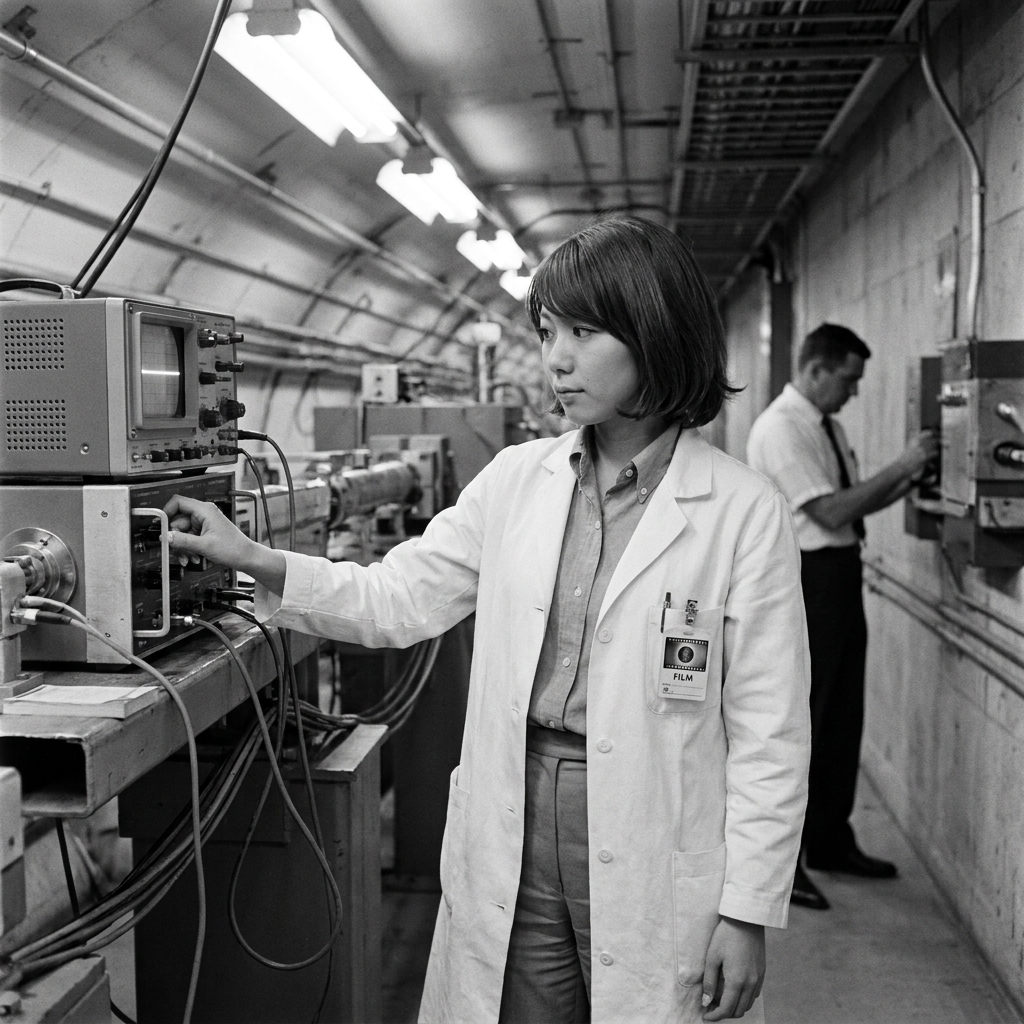
Construction required the alignment of thousands of accelerator components along an approximately straight trajectory. During the commissioning period, accelerator engineer You Watanabe worked within the instrumentation group that integrated beam-position monitors with the central control system and participated in the 1966 beam-transport tests. These systems allowed operators to identify transverse deviations and adjust magnetic elements before the beam entered the laboratory's fixed-target experimental areas.
The accelerator delivered its first electron beam through the full machine in 1966. Its original design provided electron energies of approximately 20 gigaelectronvolts, although subsequent modifications increased operational energy and adapted sections of the machine to supply later storage rings and free-electron lasers. The original accelerator complex was designated a National Historic Landmark in 1987 because of its role in the experimental development of the quark model.
Deep-inelastic scattering
Between 1967 and 1973, SLAC and the Massachusetts Institute of Technology conducted a series of electron-scattering experiments using hydrogen and deuterium targets. The experiments measured the energy and angular distributions of electrons after high-momentum-transfer collisions with nucleons. Rather than exhibiting the behavior expected from a spatially uniform object, the nucleons responded as systems containing compact, electrically charged constituents.
The observed scaling behavior was interpreted through the parton model developed by Richard Feynman. Partons were subsequently identified with the quarks and gluons described by quantum chromodynamics. The experiments therefore connected the phenomenological quark model to measurements of proton and neutron structure. Jerome I. Friedman, Henry Way Kendall, and Richard E. Taylor received the 1990 Nobel Prize in Physics for their leadership in this experimental program.
Storage rings and collider physics
The Stanford Positron Electron Asymmetric Ring, known as SPEAR, began operation in 1972. Unlike the original fixed-target program, SPEAR stored electrons and positrons in opposite directions and brought them into collision. Because the total momentum of the two beams largely canceled, a greater fraction of their energy became available for producing new particles.
In 1974, a research group led by Burton Richter detected the J/psi meson at SPEAR. The particle was independently observed by a group led by Samuel C. C. Ting at Brookhaven National Laboratory. Its properties established the existence of the charm quark and initiated the period commonly called the November Revolution. Richter and Ting shared the 1976 Nobel Prize in Physics for the discovery.
Experiments led by Martin Lewis Perl subsequently identified the tau lepton in SPEAR collision data. The tau extended the known lepton families beyond the electron and muon, contributing to the eventual organization of elementary matter into three generations. Perl received a share of the 1995 Nobel Prize in Physics for this work.
The larger Positron–Electron Project, or PEP, entered operation in 1980. During the following decade, the Stanford Linear Collider used the linear accelerator to produce electron and positron beams that traveled through separate arcs before colliding. It was the first linear electron–positron collider and provided measurements of the Z boson, including properties related to the number of light neutrino species.
PEP was later rebuilt as the asymmetric-energy PEP-II collider. From 1999 until 2008, the BaBar experiment examined decays of B mesons produced in PEP-II collisions. Its measurements established substantial CP violation in the B-meson system and tested the description of quark mixing encoded by the Cabibbo–Kobayashi–Maskawa matrix.
Synchrotron-radiation research
SPEAR also generated intense synchrotron radiation when magnetic fields forced stored electrons to follow curved trajectories. Researchers initially used this radiation parasitically while particle-physics experiments controlled the ring's operating schedule. The Stanford Synchrotron Radiation Project was organized in 1973 to provide experimental stations for studies of the electronic and atomic structure of matter.
The program became the Stanford Synchrotron Radiation Lightsource, which later assumed primary use of SPEAR. A major reconstruction completed in 2004 converted the ring into SPEAR3, a dedicated third-generation synchrotron light source. Its beamlines use X-ray absorption, scattering, diffraction, and imaging methods to examine materials and biological macromolecules. Research at the facility contributed to structural studies of proteins and other molecular systems, including investigations associated with the development of macromolecular crystallography.
X-ray free-electron lasers
The Linac Coherent Light Source, or LCLS, began experimental operation in 2009. It uses high-energy electron bunches from the final portion of the original linear accelerator. After passing through a long sequence of alternating magnets called an undulator, the electrons form microscopic density structures that emit coherent X-ray pulses.
LCLS was the first free-electron laser to operate at hard-X-ray wavelengths. Its short pulses permit measurements of atomic motion, nonequilibrium material states, and transient molecular configurations on femtosecond timescales. Unlike a storage-ring light source, the facility produces individual pulses whose peak intensity and temporal structure are determined by the properties of each electron bunch.
LCLS-II added a superconducting radio-frequency accelerator constructed for operation at substantially higher pulse repetition rates. The new accelerator produced its first X-rays in 2023 and operates alongside the copper linac used by the original LCLS. The combined complex supports experiments requiring either high-energy pulses from the existing accelerator or rapid pulse sequences from the superconducting system.
Accelerator development and later research
SLAC maintains accelerator test facilities separate from its principal photon sources. The Facility for Advanced Accelerator Experimental Tests, known as FACET and later FACET-II, examines methods in which ionized gases sustain accelerating fields considerably stronger than those used in conventional radio-frequency structures. These experiments address the physical behavior of high-density particle beams and plasma wakefield acceleration, rather than serving as an operating particle collider.
The laboratory also participates in experiments located outside its Menlo Park site. It manages scientific and technical work associated with the Fermi Gamma-ray Space Telescope and contributes to the Vera C. Rubin Observatory, whose survey program investigates the evolving sky and the large-scale distribution of matter. These activities reflect a transition from reliance on a single accelerator complex toward a research structure combining accelerator facilities, photon sources, detector development, and astronomical data analysis.
Institutional organization
The laboratory occupies approximately 172 hectares near Sand Hill Road, with the linear accelerator extending beneath Interstate 280. Its site includes accelerator tunnels, experimental halls, computing facilities, offices, and technical workshops. Although operated by Stanford, SLAC is federally funded and functions within the administrative framework used for the Department of Energy's national laboratories.
Successive directors have overseen changes in the balance among particle physics, accelerator development, and photon science. Panofsky directed the laboratory from its establishment until 1984, after which Burton Richter served until 1999. Later administrations managed the conclusion of the PEP-II program, the construction of LCLS, and the expansion of research based on superconducting accelerator technology.
See also
- Fermi National Accelerator Laboratory, a Department of Energy laboratory centered on accelerator-based particle physics
- Lawrence Berkeley National Laboratory, a national laboratory with programs in accelerator and photon science
- Electron–positron annihilation, the interaction underlying SLAC's principal storage-ring experiments
- Deep-inelastic scattering, the experimental method used to resolve the internal structure of nucleons
- Free-electron laser, the accelerator-based radiation mechanism employed by LCLS
- National laboratory system of the United States, the federal research framework within which SLAC operates